

01
VRP – Continuous Impact Pneumatic Linear Vibrators
VRP series pneumatic vibrators generate a powerful and continuous impact force using compressed air. Inside the housing, a piston moves in a linear reciprocating motion and repeatedly strikes the body of the unit. The energy created by this movement is transferred to the mounted surface at high frequency, helping to promote the movement of bulk materials and prevent material build-up.
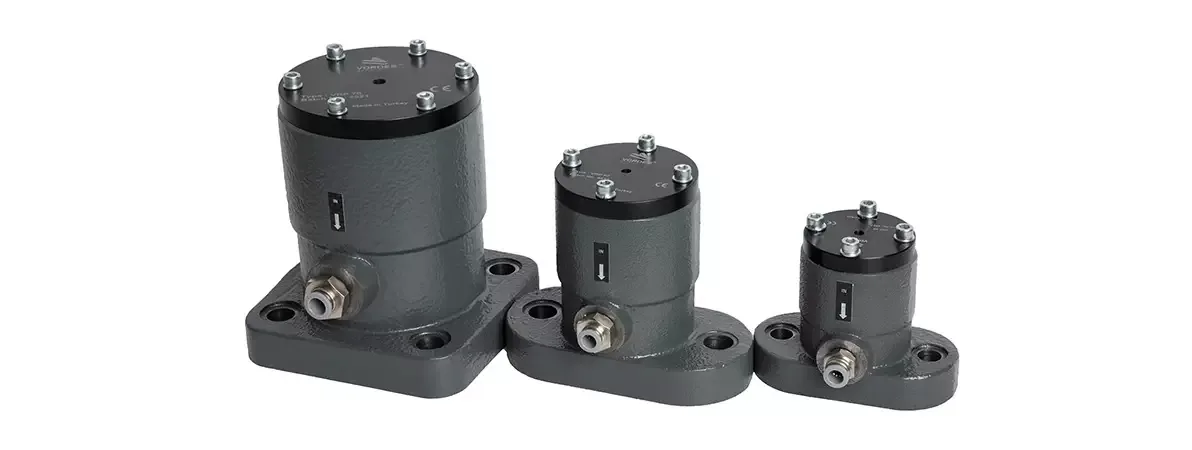
Gallery
Body sizes and installed views of the VRP continuous impact range.
Technical overview
What is a Pneumatic Vibrator?
A pneumatic vibrator is an industrial device that converts compressed-air energy into mechanical vibration or repeated impact. It is commonly installed on silos, hoppers, bins, chutes and other bulk-material handling equipment where powders, granules or similar materials may compact, adhere to internal walls or stop flowing freely.
In the VRP series, the vibrating effect is created by an internal piston rather than an electric motor. Compressed air drives the piston back and forth inside the housing, producing a sequence of strong linear impacts. These impacts are transmitted through the mounting surface and into the equipment structure, helping to loosen material that has become compacted or stuck.
Pneumatic vibrators are particularly useful in applications where material flow is affected by moisture, compaction, friction or the physical characteristics of the stored product. Because the operating force is generated pneumatically, the vibrator can provide a simple and effective flow-assistance solution in many industrial environments.
What is a Pneumatic Vibrator Used For?
Pneumatic vibrators are used primarily to improve the movement and discharge of bulk materials. They help prevent or reduce common flow problems such as bridging, rat-holing, material adhesion and residual build-up inside storage or process equipment.
VRP continuous-impact pneumatic linear vibrators can be applied to silos, bins, bunkers, hoppers, chutes and discharge sections where material does not move consistently under gravity. Repetitive impact transfers mechanical energy through the equipment wall and helps break up compacted areas, allowing the stored material to continue moving towards the outlet.
They are suitable for many powders, granular products and other bulk solids that may become difficult to handle because of humidity, stickiness or compaction. The vibrator can therefore support more reliable material discharge and reduce the need for manual intervention when flow becomes restricted.
How does Pneumatic Vibrator Work?
A pneumatic vibrator operates by using compressed air to move an internal piston. When compressed air enters the housing, the piston travels through the cylinder and produces a mechanical impact. The pneumatic cycle then redirects or releases the air so that the piston can return and repeat the movement.
In the VRP series, this reciprocating motion creates continuous linear impacts at a high frequency. Each impact is transferred from the vibrator body to the surface on which the unit is mounted. The resulting mechanical energy passes through the wall of the silo, hopper or other equipment and acts on the material inside.
The effectiveness of the system depends on factors such as air pressure, vibrator size, mounting position, equipment construction and the characteristics of the material being handled. Correct positioning is important because the impact energy must reach the area where material tends to accumulate or lose its natural flow.
Pneumatic Vibrator Prices
The price of a pneumatic vibrator can vary according to the model, size, required impact force and the equipment needed for the pneumatic installation. The correct unit should therefore be selected according to the application rather than on price alone.
Factors such as vessel dimensions, material characteristics, operating conditions and the severity of the flow problem can all influence the required vibrator configuration. Selecting a vibrator that is properly matched to the application helps ensure that the available pneumatic energy is used effectively.
For current pricing and assistance in selecting a suitable VRP pneumatic vibrator, please contact the ADNA TECH team with information about your application and material-handling requirements.
Working Areas of Pneumatic Vibrator
Pneumatic vibrators are widely used in industries where powders, granules and other bulk solids must be stored, transferred or discharged reliably. Typical applications can be found in construction materials, mining, minerals, chemicals, plastics, animal feed, food processing, energy and other bulk-material handling operations.
They are especially useful where materials tend to compact, stick to equipment surfaces or become difficult to discharge because of humidity or their physical properties. Products such as powders, sand-like materials, mineral products and similar bulk solids can develop irregular flow patterns inside silos and hoppers.
By applying controlled mechanical impact to the equipment structure, pneumatic vibrators help restore material movement and support a more consistent discharge process. The final vibrator type, size and installation position should always be selected according to the material, equipment geometry and operating conditions of the specific application.
