

12
Mixers
Industrial mixers are used to combine powders, granules and other process materials into a controlled and consistent mixture. The mixer configuration is selected according to whether the process operates in individual batches or continuously, as well as the characteristics of the ingredients, required throughput, mixing quality and any liquid-addition requirements.
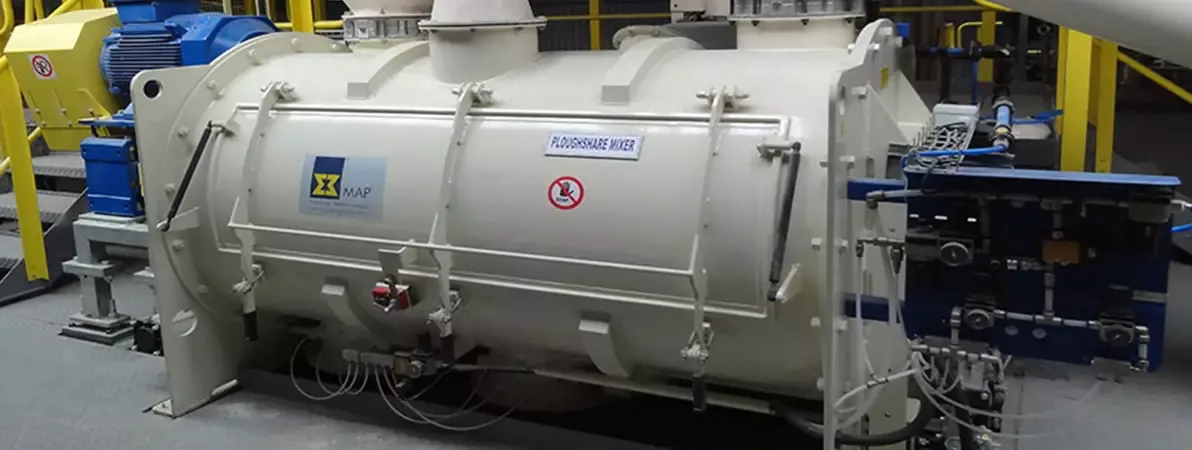
Gallery
Batch and continuous single shaft mixing equipment.
Technical overview
Single-shaft mixing systems can use ploughshare or inclined blade-type tools to move material through the mixing chamber and create intensive interaction between the product particles. The ADNA TECH range represented on this page includes WBH Batch-Type Single Shaft Mixers and WAH Continuous Single Shaft Mixers.
What is a Mixer?
A mixer, also referred to as a blender, is a machine designed to combine two or more materials so that the components are distributed throughout the resulting mixture. Industrial mixers are used in processes involving powders, granules and, in suitable configurations, mixtures that also require the addition of liquids.
The mixing mechanism is selected according to the product and the process objective. In horizontal single-shaft mixers, mixing tools mounted on a rotating shaft move the material within a cylindrical mixing chamber. The movement created inside the vessel continuously exposes different particles to one another and helps prevent zones in which material remains insufficiently mixed.
Industrial mixing equipment can be adapted to many sectors because the required result depends on the formulation rather than on one specific industry. Different construction materials, mixing tools, wear-protection options and process accessories can therefore be selected according to the products being handled.
The correct mixer should be chosen according to factors such as batch or continuous operation, material properties, required capacity or throughput, desired mixing consistency, cleaning requirements and the conditions of the production process.
What are the Mixer Types?
The two principal mixer models represented on this page use a horizontal single-shaft arrangement but operate according to different production methods.
WBH Batch-Type Single Shaft Mixers process a defined quantity of ingredients as an individual batch. Materials are introduced into the mixing chamber, mixed for the required cycle and then discharged before the next batch begins. This operating principle is suitable where repeatability between individual batches and controlled formulation are important.
WAH Continuous Single Shaft Mixers are designed for continuous production. Ingredients enter the mixer while mixed material leaves through the opposite end, allowing the process to operate as an ongoing material flow rather than as separate batches. The mixing quality is developed as the material passes through the mixing chamber towards the outlet.
Both designs use a horizontal mixing chamber with a shaft carrying appropriately arranged mixing tools. Depending on the process, ploughshare or inclined blade-type tools can be used to lift and move the product, creating intensive particle movement inside the chamber.
Separately driven high-speed choppers may also be incorporated where the application requires an additional mixing effect. Liquid-addition equipment and other process accessories can be specified according to the selected mixer and formulation.
The distinction between the two product families is therefore fundamental: WBH is the batch-type mixer range, while WAH is the continuous mixer range. Selection depends on whether the production process requires individual reproducible batches or a continuous material stream.
What are the Features of the Mixer?
Mixer features vary according to the product series, application and selected configuration. The basic mixing principle relies on mechanical movement generated by the rotating shaft and mixing tools inside the chamber.
Typical operating characteristics include:
- Ploughshare or inclined blade-type mixing tools arranged on a horizontal shaft.
- Intensive movement of the product particles within the mixing chamber.
- Reduction of slow-moving zones or dead spots through the movement created by the mixing tools.
- Optional high-speed choppers where additional mixing action is required.
- Configurations for the addition of liquids where required by the process.
- Heavy-duty mixing chambers available in different construction materials according to the application.
- Different shaft-sealing arrangements depending on operating requirements.
- Drive power and equipment configuration selected according to the material and required performance.
WAH continuous mixers operate with material entering at one end of the horizontal cylindrical chamber and leaving from the opposite end. The mixing tools lift the components from the product bed into the active mixing zone so that the desired mixture is developed before the material reaches the outlet.
WBH batch-type mixers instead retain a defined charge in the mixing chamber for the selected mixing cycle and then discharge that completed batch. Manufacturer documentation specifically identifies the WBH range as batch-type single-shaft mixers designed for reproducible batch production.
Construction, wear protection, surface finish, mixing tools, seals and optional accessories should therefore be specified according to the actual material and operating environment rather than assumed to be identical for every mixer configuration.
Advantages of Mixer Models
Single-shaft mixer systems provide several operational advantages when the correct batch or continuous configuration is selected for the process.
Typical advantages include:
- High mixing homogeneity.
- Controlled and consistent mixture quality.
- Mixing action designed to involve the complete product mass.
- Reduced formation of dead spots within the mixing chamber.
- Mixing tools that can be selected according to the application.
- Optional high-speed choppers for processes requiring additional mixing intensity.
- Construction options for abrasive or demanding materials.
- Liquid-addition options for suitable formulations.
- Drive and equipment configuration adaptable to the application.
- Access for inspection, maintenance and cleaning according to the selected design.
Batch operation provides a clear separation between individual production cycles and is appropriate where formulations must be processed as defined charges. Continuous operation is more suitable where ingredients must be mixed as an uninterrupted material flow.
For this reason, WBH and WAH should not be treated as interchangeable descriptions of the same operating method. WBH Batch-Type Single Shaft Mixers are selected for batch production, while WAH Continuous Single Shaft Mixers are selected for continuous processing. The appropriate model should be determined from the recipe, material characteristics, required production method and operating conditions.
