

08
Rotary Valves
Rotary valves are used in bulk-material handling systems to discharge powders and granular products in a controlled manner. Installed beneath silos, bunkers, cyclones, filters and similar equipment, they allow material to pass through a rotating cellular rotor while helping limit the uncontrolled movement of air through the discharge point.
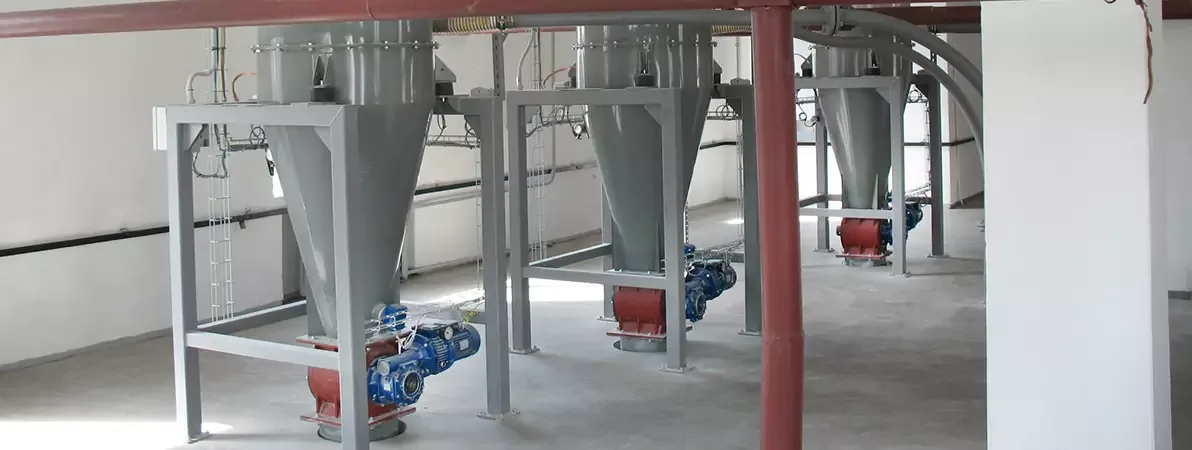
Gallery
Drop-through and blow-through rotary valve configurations.
Technical overview
Different rotary-valve designs are available according to the application, material characteristics and conveying arrangement. Drop-through and blow-through configurations can be selected for feeding or discharging dry bulk materials into downstream equipment or pneumatic conveying systems.
What is Rotary Valve?
A rotary valve is a mechanical component used to control the discharge of powders, granules and other dry bulk solids from storage or separation equipment. It is commonly installed beneath silos, bunkers, cyclones and dust collectors where material must be transferred at a controlled rate into the next stage of the process.
The equipment is also widely referred to as a rotary airlock, star valve, cellular wheel valve or airlock. Its rotor contains a series of pockets that receive material at the inlet and carry it towards the outlet as the rotor turns.
Rotary valves are particularly important in pneumatic conveying systems because they allow bulk material to enter or leave the conveying line while restricting unwanted air movement through the valve. Depending on the application, housings may be manufactured from materials such as carbon steel, cast iron or stainless steel.
How Does the Rotary Valve Work?
A rotary valve operates through a horizontally mounted rotor rotating inside a close-fitting housing. Bulk material enters the rotor pockets from above and is carried around with the rotor until it reaches the discharge side, where gravity allows the material to leave the valve.
As the rotor turns, the pockets provide a controlled passage for the material while the close clearances between the rotor and housing help reduce air flow through the valve. This allows powders and granules to be transferred between equipment operating under different airflow or pressure conditions.
The operating speed, rotor design, clearances and construction materials should be selected according to the bulk material, required feed rate, wear conditions and the process in which the rotary valve will operate.
What are the types of Rotary Valves?
Rotary valves are available in different configurations to suit the way material enters the valve and the way it must be transferred to downstream equipment.
Drop-through rotary valves allow material to enter through the upper inlet, pass through the rotor pockets and discharge vertically from the lower outlet. This arrangement is widely used beneath silos, hoppers, filters and other equipment where gravity discharge is required.
Blow-through rotary valves are designed for applications where material is introduced directly into a pneumatic conveying air stream. Their configuration allows the product leaving the rotor to be picked up and carried through the conveying line.
Depending on the product series and application, rotary valves may include carbon-steel or stainless-steel housings, horizontally mounted rotors, drive units and removable housing components. Standard flange arrangements support integration with associated bulk-material handling equipment, while access to internal mechanical parts can simplify inspection and maintenance.
The available product range includes RV-RVR and RVC drop-through rotary valves as well as RVS blow-through rotary valves. The correct series should be selected according to the material, capacity, conveying method and operating conditions.
